
Hello lovelies! Today I’m pleased to bring you the first installment of our ongoing series “Exploring Reggio,” a collaboration with Anna from The Imagination Tree, Kate from An Everyday Story, Ness from One Perfect Day, and Debs from Learn with Play at Home. We are all learning about the Reggio Emilia Approach together and are sharing the different ways we are implementing principles of the method at home with our children. If you missed it, here is our introductory post explaining more about the Reggio Emilia Approach (RE). This week we decided to talk about incorporating mirrors as a tool for play and learning.
Why Mirrors?
One of the key principles of the RE approach is “the environment as the third teacher.” Reggio environments and activities (often called “provocations”) are carefully constructed to encourage learning and curiosity- there is an emphasis on natural light, authentic materials/tools, order, beauty, and purpose. If you look at photos of RE learning spaces, you will often notice mirrored surfaces- walls, ceilings, tables, shelves- and see mirrors incorporated into invitations to explore, play, and create. Although these mirrors are beautiful, they are used with very specific purposes in mind. Mirrors give children the opportunity to see things from multiple perspectives and can totally change the way they interact with new materials or art mediums. For more suggestions, here is an excellent post from An Everyday Story on the use of mirrors in Reggio-inspired activities.
Using Mirrors to Explore Night
Recently my twins (age 2.75) have become very interested in the concept of night time. We believe this came about because the days have shortened with the onset of autumn- while the sun was still out a few short weeks ago when we put them to bed, now the moon is already making its appearance in the night sky for the first time in their short memories. There is lots of talk about the stars and the moon (or the “big banana”) and the “purple blue” sky. We’ve even been venturing outdoors in our pajamas on the way to bed- Sydney is completely in awe of the sparkly sky, while Will often hides his face in Daddy’s neck, not sure about the moon quite yet. It’s so interesting to look at things from their perspective- can you even imagine what it would be like for the moon to still be a novelty?
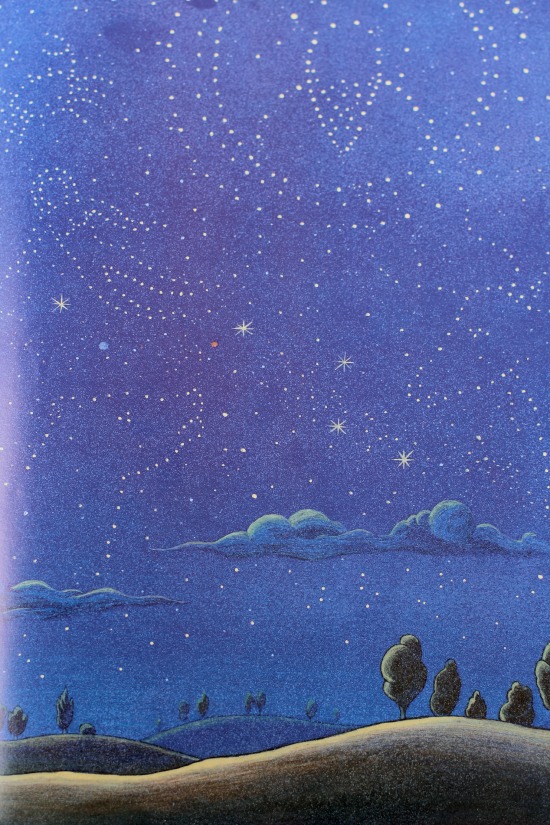
Illustration from “The Old Man Who Painted the Sky” by Teri Sloan, Illustrated by Stefano Vitale
One of our favorite books from the library last week (and that we have already ordered for our personal library) was There Was an Old Man Who Painted the Sky by Teri Sloat. Inspired by ceiling paintings in Spain’s Altamira Cave, it is a beautiful creation story about an old man who painted the heavens and the beasts with stunning illustrations by Stefano Vitale. The twins are always fascinated by the illustrations of the night sky, pointing out all the stars (“lotsa little circles, Mama!”) and looking closely at the shapes and patterns they make. They usually want to paint after we read the book, so one day I decided to set up an invitation inspired by the night sky illustration.
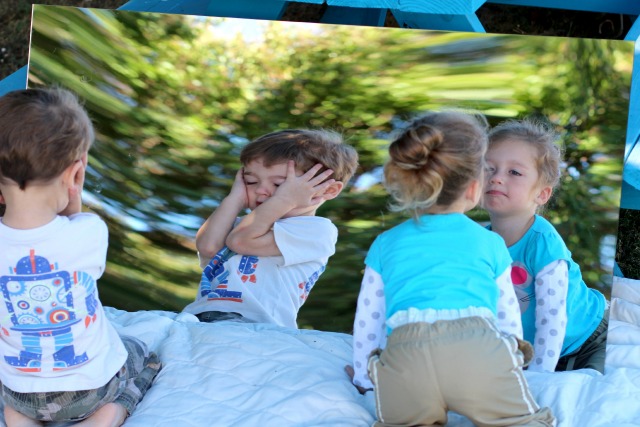
For our canvas, I chose a large sheet of mirrored acrylic that I purchased for art and construction activities at Home Depot. We have painted on mirrors before, but never with this large of a surface area! I set it up outside against our picnic table and the twins were instantly drawn to it, making silly faces and looking at the reflection of our surroundings.
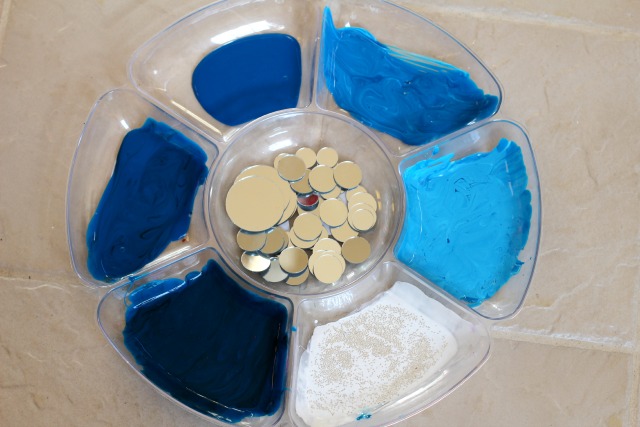
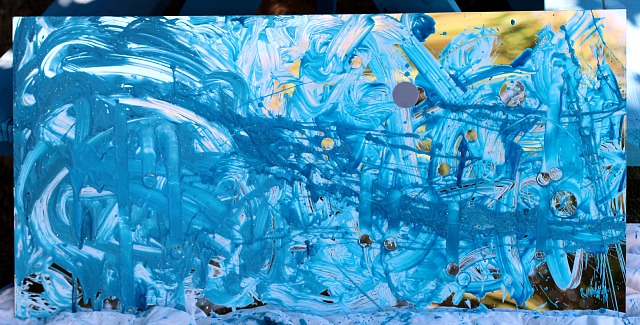
After a bit I brought out a tray of tempera paint in graduated shades of blue that we mixed together before coming outside- color is another big area of interest right now, especially comparing shades of dark and light. I thought it worked well with the exploration of day and night. I also added several packages of round mirror tiles in different sizes, thinking they might suggest light and stars. Use your judgement with these- they are glass so definitely not for use with children who still mouth or are inclined to stomp on things 😉 We didn’t have any issue with them being sharp, but if you were worried you could seal the edges with clear nail polish. You could also use circles or bits of foil or other shiny paper.
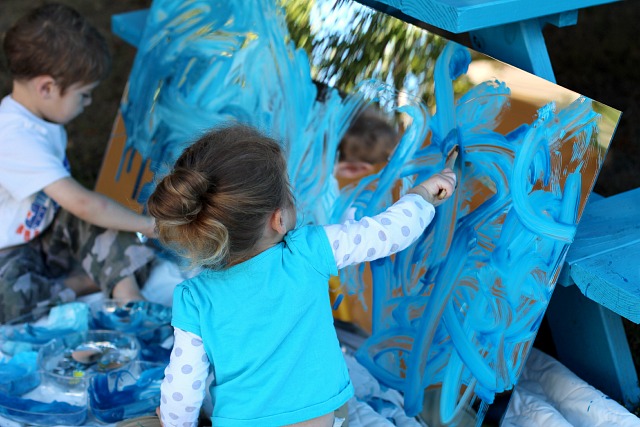
Both kiddos set about right away covering the mirror with broad strokes of color.
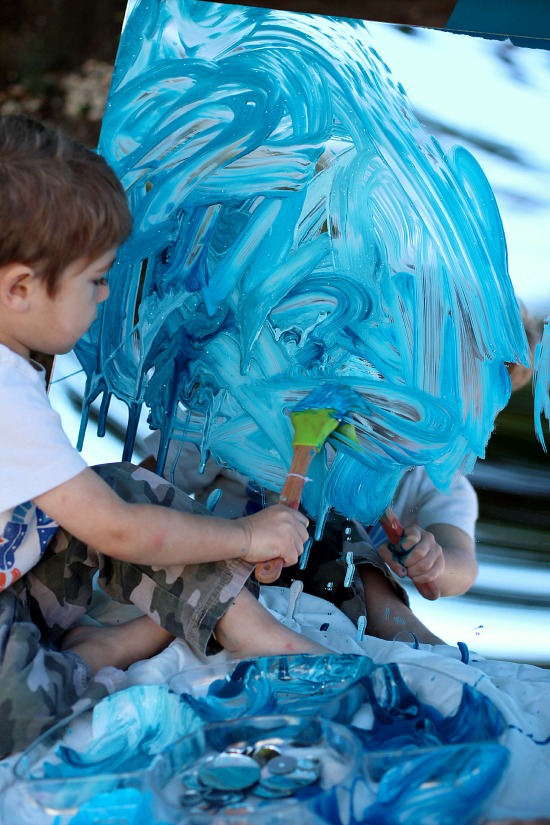
Will was especially interested in swirling and mixing the different shades of blue. He would glob the color on thickly and then put his nose as close as possible to the mirror, watching the drips travel down through the “sky.” He kept saying “I’m an old man, Mama! I’m an old man painting the night!”
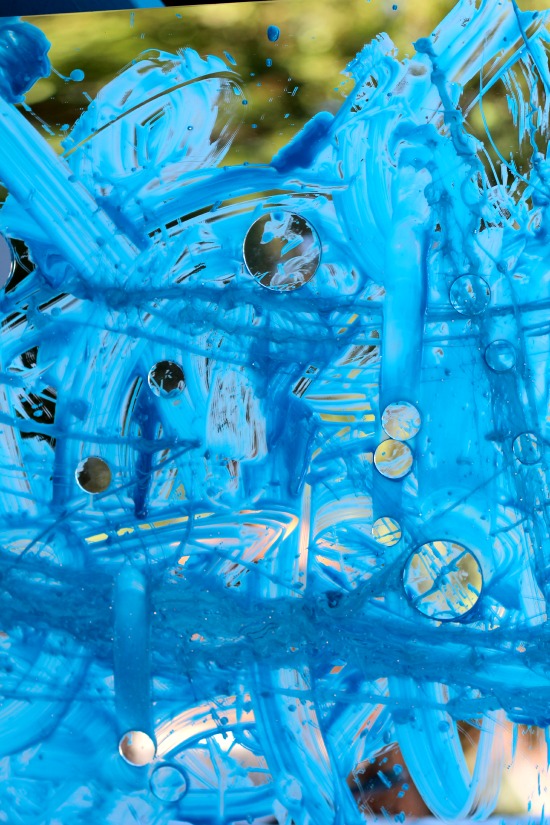
The symbolism of the round mirror tiles was not lost on the twins- they spend considerable time placing the “stars” and “moons” just right. Interestingly, the smaller tiles had a tendency to slide down through the paint, also a source of fascination (and occasional frustration).
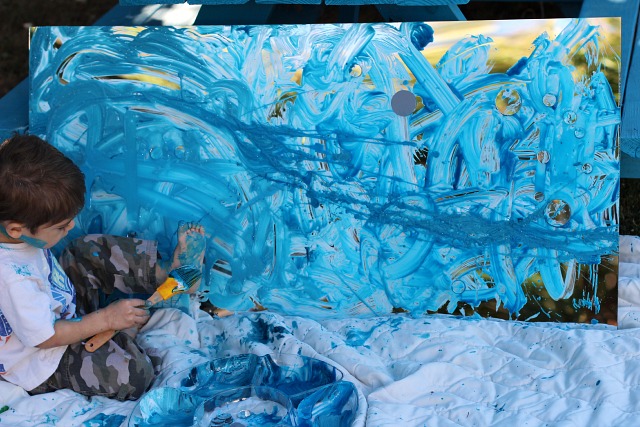
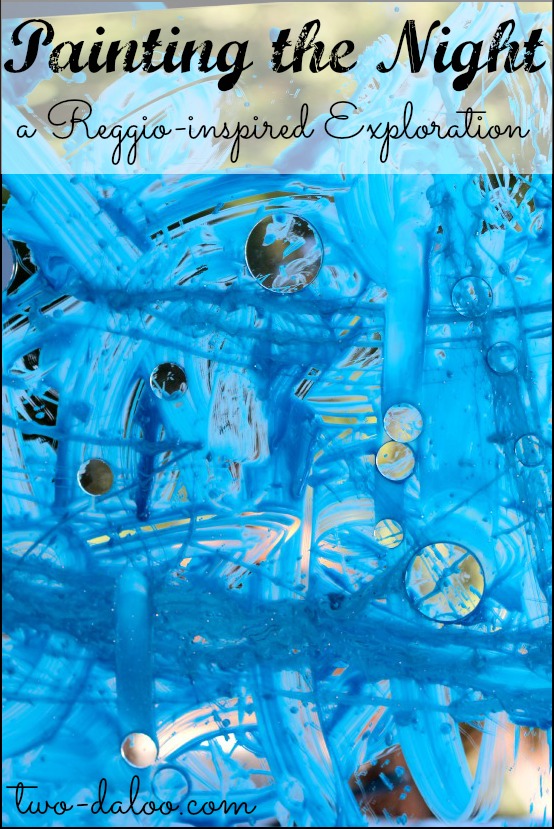
Here is a photo of the completed “sky”- you can see where Will decided to start flinging the paint onto the mirror with his brush. I knew he was done with his creation when he began painting his feet instead 😉 We admired it, photographed it, and eventually hosed it down so the mirror would be ready for another day of play and learning.
Reflections
Although the twins definitely understood and enjoyed the idea of creating art based on a book (something we haven’t tried before- most of our art has been totally open-ended), it was the swirling and mixing of shades that fascinated them both the most. Will seemed to almost be trying to get “inside” the painting when he was studying it up close and watching the movement of the paint as it slid down the mirrored surface- it gave me some cool ideas for activities to build on that interest. Painting on mirrors is something we will definitely continue doing as it hold their attention so much longer and adds a new dimension to the painting experience.
Here are some more ways we have used mirrors in our play and learning activities:
Now don’t forget to visit my partners in this collaboration for even more amazing ideas for play and learning with mirrors:
Exploring Shapes and Patterns with a Mirror Box at The Imagination Tree
Painting on a Mirror (and Monoprinting!) at Learn With Play at Home
Playdough Self Portraits at An Everyday Story
Rainbow Stacker on a Mirror by One Perfect Day
This post has been shared at some of these fabulous link parties.







This is BEAUTIFUL, Stephanie! The huge mirror, the shades of blue, the adorable quotes from the twins…I love it all!
We’ve only ever used small mirrors in play before. I’d really like to get a huge one like yours.
What an amazing post! Beautifully written and so informative - and the artwork is amazing too! I am very excited to be following this series - a topic I am most interested in learning more about. To Home Depot we go!
Oh I love everything about this post! It’s beautiful, helpful and inspiring. Thank you for sharing, I’m enjoying this series so much (helps that you’re all bloggers I follow already and admire!)
Wonderful! Gorgeous activity. I love the idea of the little mirror stars. I’m following your Reggio work with real interest.
This is amazing Stephanie! I love everything about - the mirror as canvas, that it was done outdoors, the mirror stars. How beautiful. I can think of so many uses for that huge sheet of acrylic mirror. I might be paying a visit to our hardware store this week!
This is super cool! It looks like they had a great time creating!
Thanks for sharing where you got your acrylic mirror. I’ve never been able to find one at a decent price point. Great post!
Oh that huge mirror is awesome!! What a fabulous exploration for you and your kids
Ooh, I’d love a mirror like that one. What a fabulous exploration for the kids. We’ll be having a go at this for sure, as I too found that painting on the mirrored surface really did hold their attention for a long time! Love the different shades of colour and the end result looked great!
Land expense loans aree of diverse types and each of the financial loan is tailor-built to meet the wants of certain investors annd not other people.
Many times a property simply needs tender loving care, requiring nothing more than a fresh coat of paint or innovative landscaping, or perhaps minor d.
Article Source: Armstrong Property Course, Financial Freedom,
Property Investment.